Monday, May 15, 2006

Reemergence

Ah -- as promised, I've gotten lazy with the blog, but these days it's not for want of activity. Although it doesn't help that the state of Assoul's electrical generator is such that I now rejoice on those rare nights when the lights do come on. In theory, I use those evenings for "other work on my computer," although in reality that often translates to watching DVDs. But the electric lines are slowly making their way to us... maybe even in a month or two! (And then you can all call me on my cell phone too!!)

I must say, I was also feeling a bit uninspired after I returned from a few weeks away in March. The women in my nedi, many of whom I find individually inspiring, can be a little more difficult to motivate and pacify as a group. In spite of pockets of ambition and talent, the whole organization seems to get bogged down in petty disputes, many of which are old news and ought to be let go! But slowly, they're moving forward, and after a meeting with a government official a couple of weeks ago, they're working on the legal paperwork to form a cooperative. This is a really big deal -- offering real business opportunities for women both inside and outside the nedi who are willing to make the necessary investments. Moving forward then, the biggest issue is going to be cultivating some leadership. I have to remember all of the social influences working against this goal, where women who are truly capable nevertheless remain somewhat shy to take formal responsibility (even those who work very hard behind the scenes), and sometimes are even most afraid of each other!

I have to mention one woman, however, who is truly impressing me these days. And this is out of several suprisingly sophisticated and well-educated women I've encountered in spite of Assoul being such an isolated village. Bzi, who is quietly motivated and appears to be above the daily nedi strife, will sit and talk to me about her interests and questions. For a woman who never completed school, she has an amazing level of intellectual curiosity. She tells me she has French language copies of Marx and Shakespeare at home. I look through my notebook and see places where she has diagrammed theories she remembers from her geometry and physics classes. In a group where one woman I spoke with didn't even realize that there was a large ocean between Morocco and the United States, Bzi is telling me that she wants to learn Spanish, and knows about Macchu Piccu when I mentioned my one and only trip to South America. In a way, I am embarassed, because when I arrived in Assoul, I feared that the only intellectual interactions I might be able to have would be with some of the men (in truth, I have to be careful where I step on that front, as they realize I like talking international politics, and of course as a Peace Corps Volunteer, I should only go so far with that sort of thing. So mainly I try just to listen...)

Anyway, I've been working harder to stay on top of my reading list (including my "spinach" -- i.e. stuff that is good for me, if not always entertaining). One thing that no doubt pulled me out of my motivational funk last month is Tracy Kidder's Mountains Beyond Mountains. This book had been recommended to me multiple times by various (reliable) sources, and now I must do the same, particularly for those of you interested in the developing world, human rights, public health, or simply reading about amazing people.

As I wait for this cooperative situation to pull together (well, I am involved in that too, but here I am a "facilitator"), and just to keep from feeling completely useless, I've gotten involved in some other activities here and there. Mainly there. Meaning I'm spending less time in Assoul for the next month or two. But more on that another day... I've definitely learned to accept the local attitude that things will happen if they happen.

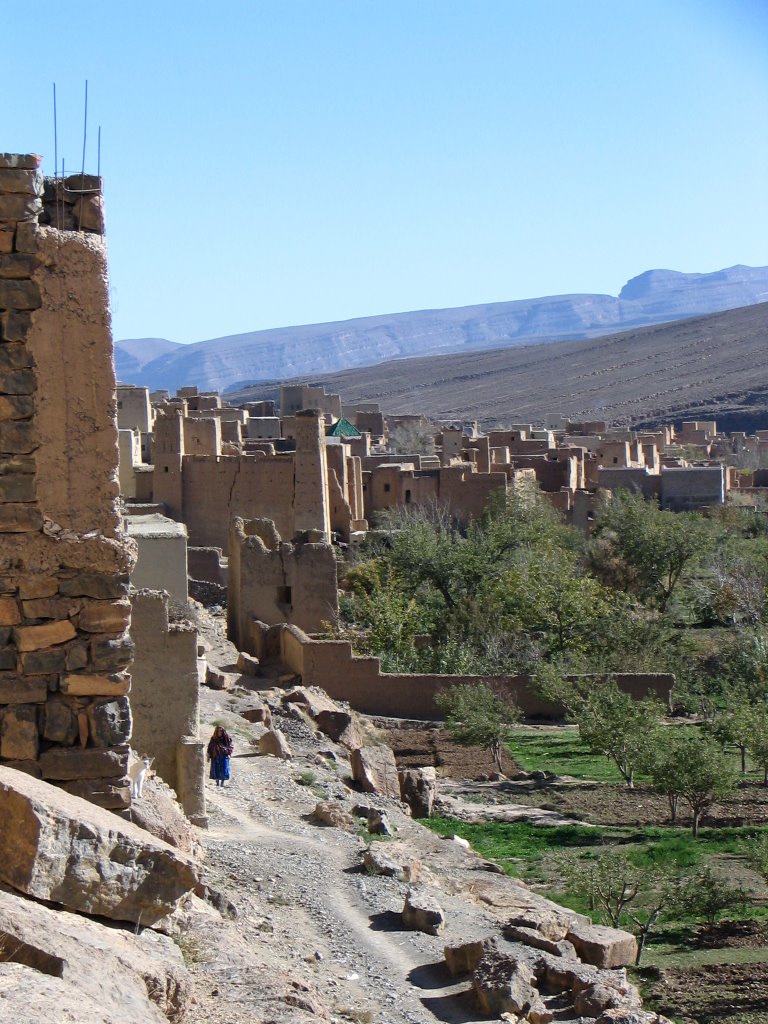
Here's a pic of some of the beautiful landscapes in a nearby village where I might do some work. I cannot overemphasize how little justice my camera does to my surroundings.

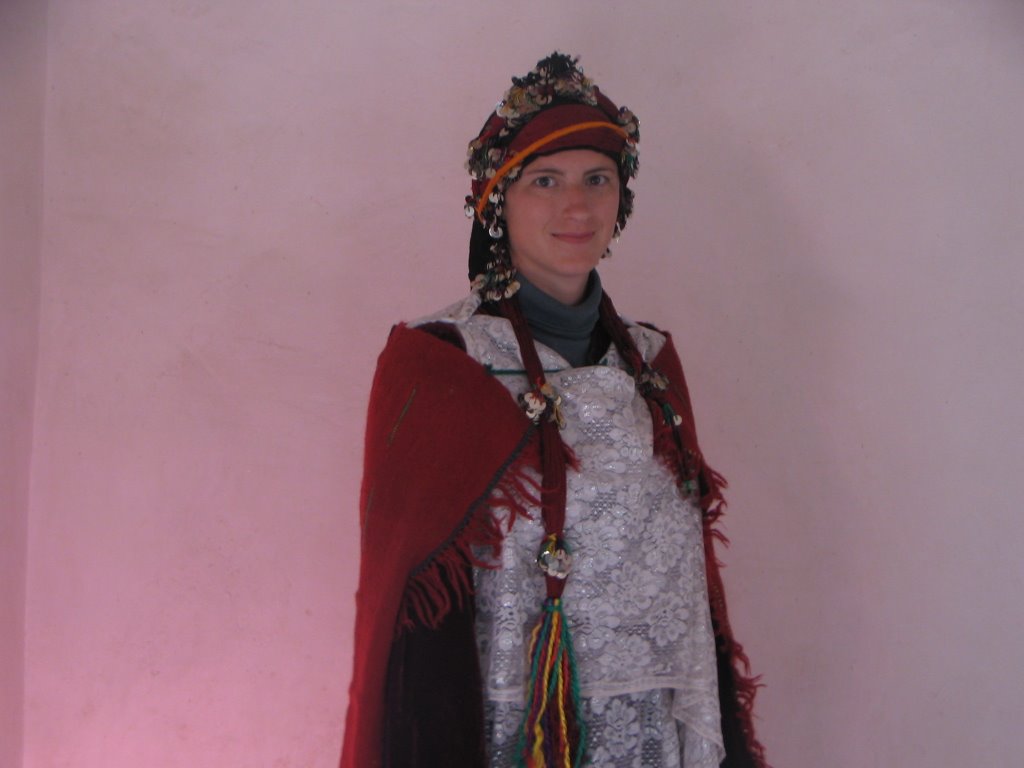
And here is me being forced to dress up (yet again) like a Berber bride by some folks in said village. This game may never stop. The women in my nedi had been threatening to do it too, and they got me last week -- one day being disappointed that I didn't have my camera with me, and the next day (after seeing this photo) deciding that the wardrobe they'd offered was inadequate. So I think I am getting this again when I return home at the end of this week!

I inherited a pressure cooker and a shortwave radio from a colleague who returned to the US a couple of months ago. The former I hadn't intended to purchase, in spite of it being a handy way to cook beans, because I didn't want to add any more potential explosives to my housewares. Now I live in fear, but I've been enjoying lentils (my fave!) on a more regular basis. The shortwave I'd also declined to purchase after standing around souk for half an hour one morning trying, without success, to locate BBC or anything else in English. Fortunately, I seem to have slightly better luck with the inherited one. It may have lots of static and require constant adjustments, but at least I'm not getting all of my news between one week and two months late now! (Case in point, my friend Jackie just handed me an October issue of The Economist, which had apparently made a little trip to Iran before finding its way back to her small village!).

I also now own my first djellaba -- an impulse buy, I'm afraid. Even though I'd been thinking of getting some nice, traditional garments as souvenirs before I return to the US, there is no need for such a thing right now! The nicest outerwear I ever see on the women of Assoul is a taharuwit (I've no doubt butchered that attempt at transcription!) -- a thin, black, embroidered cape that is common in the south. Anyway, my purchase followed a meeting in the city of Khenifra (adding one more amazingly beautiful yet completely different landscape to my list of gorgeous Moroccan drives!), where I was pleased to catch up with a number of friends whom I hadn't seen in months. [You know, I think some of us have these fantasies about "going native" (sorry to be a little politically incorrect) as Peace Corps Volunteers, but as it turns out, I have to say that I am grateful that I see fellow volunteers a lot.] While in Khenifra, I visited a tailor shop where one of my colleagues does some work. Well, I was just browsing (and coveting some really fancy, expensive stuff), when I must have blacked out or something, because next thing I knew they were putting a djellaba on me. When it didn't turn out to be a boxy monstrosity or a ridiculous price, I just couldn't say no. Of course, now, lazy person that I am, it's just sitting in a plastic bag getting wrinkled. But I could wear it, if the need ever arises... A couple of my friends and I also were invited to a nice meal at the tailor's nice house afterwards. Until midnight. So I was awake all night digesting kefta (meatballs), but, thankfully, had a buddy present who likewise seemed to be experiencing some insomnia. I suppose the Moroccan dining schedule is somewhat more tolerable if you have the right company to share it with! [For lack of any other Khenifra photos -- I never do well snapping pix from the bus -- here's me playing dress-up again in my new djellaba.]
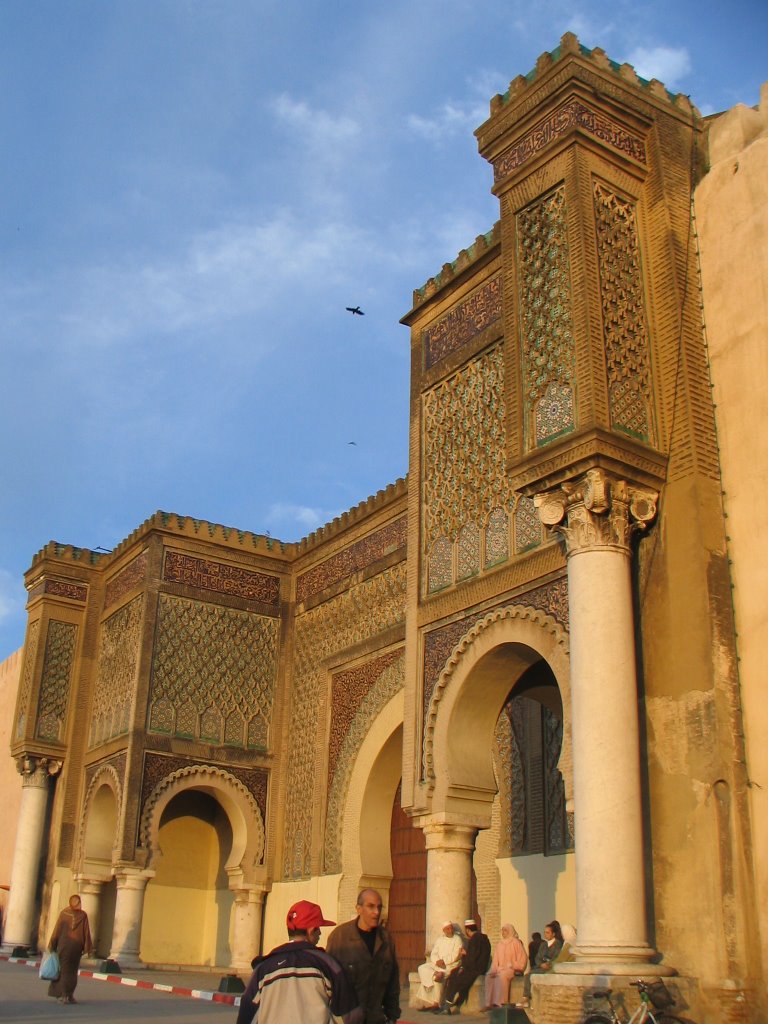
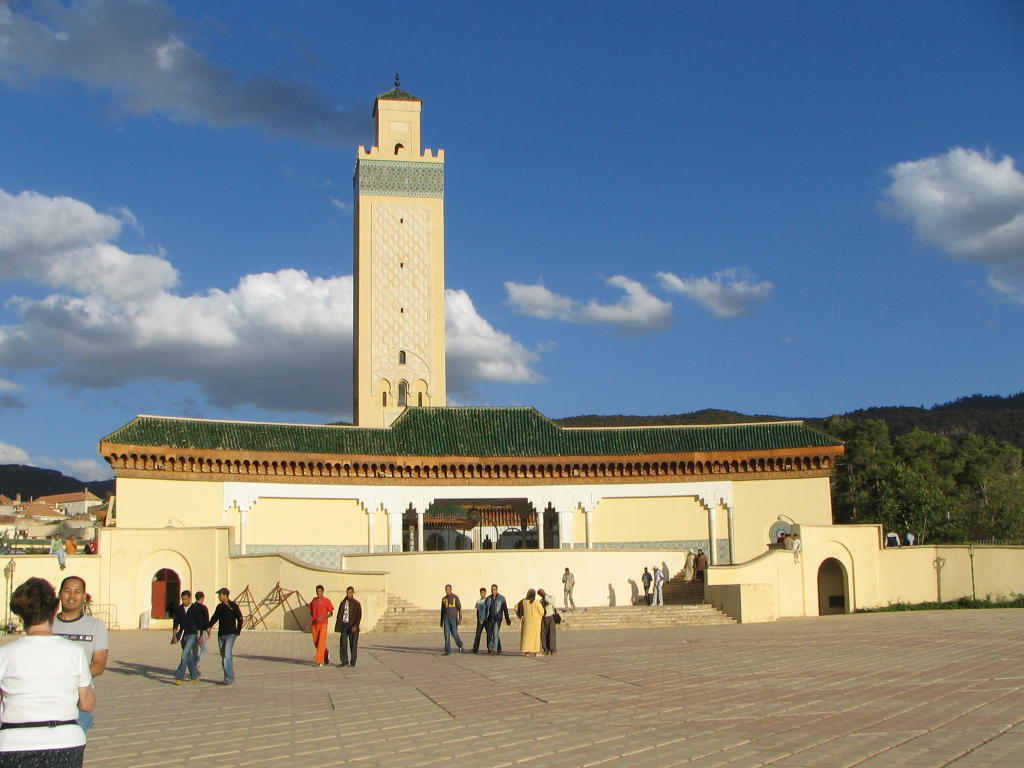
Two weekends ago, I made my first real trip to Meknes (meaning I saw something besides the taxi stand) with a couple of friends. Unfortunately, with just one night to explore (and of course squeeze in a trip to Marjane -- Morocco's answer to Walmart, and I still hate it, as much as I suppose I occasionally need it), I'm already ready for another trip back. But I did make it to a couple of classic sites, including the Bab El-Mansour and a beautiful mederssa hidden inside of the medina.
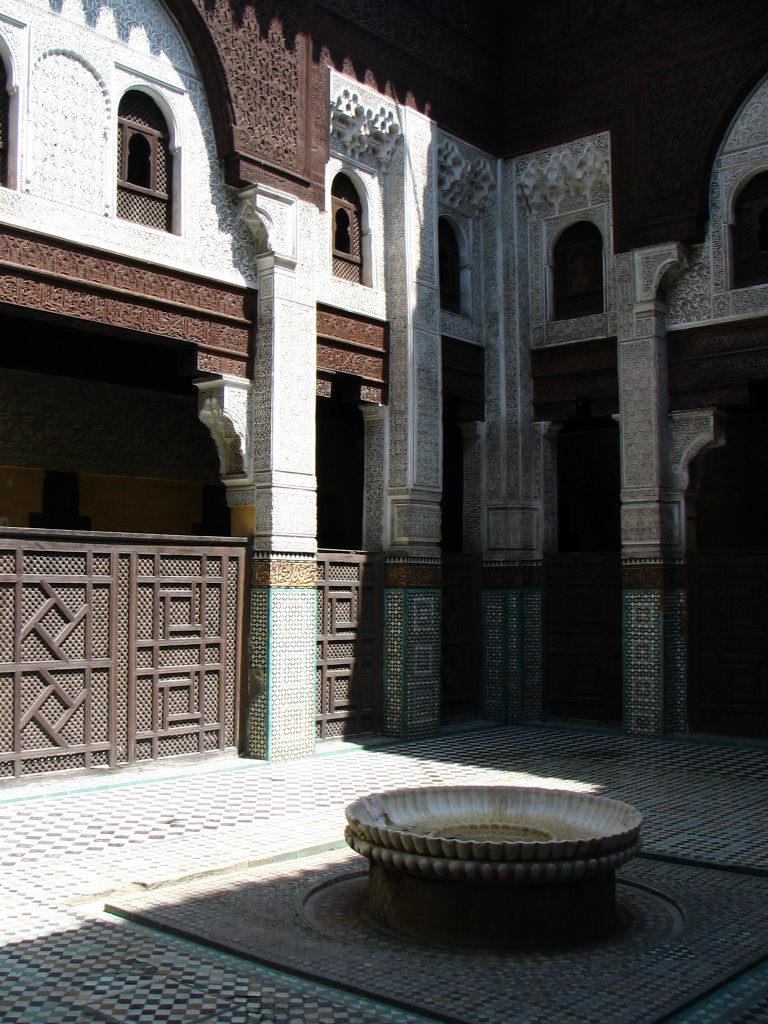
I realize I must start playing tourist a little more before two years have passed and I haven't "seen anything." And then there is that little matter of escaping from the "bled," as we call it. Ahhh, cities... Where you can eat pizza and pistachio ice cream, hang out with your guy friends without everyone thinking that you're a slut, and where you can simply tell off some stranger who's pissed you off in the street without worrying that it will come back to haunt you in your village of 2,000! (Assoul is beautiful, but I think my experiment in long-term rural living will end when my Peace Corps service does!)


This is not a joke. It is an actual photo of actual toothpaste (or so it says) bought by my friend Anne here in Morocco. Maybe the Peace Corps Small Business Development Program should branch out and do some marketing advice for bigger companies.


We could also talk to the hanuts (shops) that sell eggs with dried, crusty bird droppings and occasional feathers still stuck to the shell. But then, you take what they give you... guess it doesn't hurt business.


Monday, April 17, 2006

A New Level of Jealousy!

Not being a "language person," I realize that it is as much my fault as anyone else’s that I have yet to hold anything remotely resembling a substantive conversation in Tamazight! Absolutely, I can understand and answer questions like, "Where did you go?" "What time is it?" or "What did you eat?" And of course I am quite adept at saying "I’m sorry, I don’t understand"!

Occasionally, well, sometimes more than occasionally, I find myself frustrated by an apparent lack of tact or nuance in the language as well. For example, it is difficult to express degrees of ability, need, or emotion. There is either "a lot," "a little," or "none." And while there is "better" and "worse" (although I have been advised to be careful on with the latter, because if you linger a little to long over one consonant, it sounds more like an offensive bodily function!), it is sometimes difficult to express "more," or "less" in exactly the way we’d mean it in English. With all this, not only do I often feel incapable of expressing myself as specifically as I might in English (even if I did speak better Tamazight), but I often find myself feeling unnecessarily offended by what appear to be rather blunt statements made to me ("You don't know anything!")!

That said, Tamazight also has a range of bizarrely specific words - verbs in particular. There is actually a verb (a single word) for the act of scraping meat off of bones with your teeth. But most interesting to me, during a recent tutoring session, was learning the word that roughly describes our concept of jealousy or envy. For us, those ideas - the latter in particular - suggest a notion of "I want what you have." The Tamazight word, "lshrah," however, carries a far nastier connotation (not that we don’t sometimes think of it this way in English as well). If you feel lshrah towards someone, it means, simply, "I don’t want you to have what you have."

Normally, I am fascinated by the idea of what the specifics of a language say about its culture, but I am learning that, when you’re living in the middle of it, sometimes it is best to take what lessons you want from such things, but try not to dwell on it!

Sunday, February 12, 2006

My Refuge

So, after a sad goodbye to my host family, who kept asking me to stay “just one more night,” or “just until spring” (apparently my host sisters told my host mother that my house is freezing, although of course it’s no colder than theirs!!!). I have finally moved into my own place. It’s on the other side of town, not that that’s very far, and of course I visit or at least see one of them nearly every day! Frankly, I love the host fam, and certainly could have managed living there if I had my own mattress (those ponges look comfortable, but they actually kill you slowly after sleeping on them for two months!). Nevertheless, it is nice finally to have my own space, where I can eat what and when I want, use the toilet without everyone knowing, bathe without feeling guilty for asking my already hard-working host mother to heat up a kettle of water, and just generally be myself without having to worry about being watched so closely!

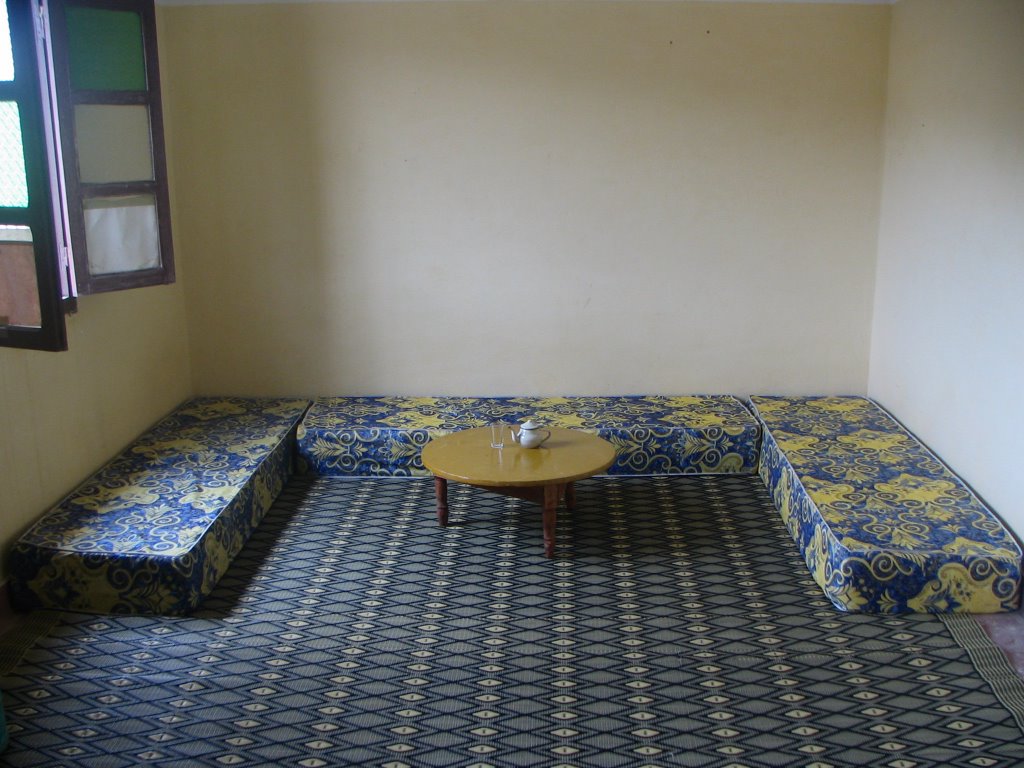
My place is HUGE too – for those of you who saw any of my apartments in NYC or Cambridge, you’ll understand why I find this one to be a tad overwhelming. The salon alone is far larger than any of my NYC places, and rivals the overall square footage of my Cambridge apartment. Actually, what we would call the foyer in the US (basically unused space here) is bigger than any of my NYC apartments. My intention had been to buy as little furniture as possible, and although I insist on remaining minimalist (not like I am taking this stuff home in two years!), I have had to adjust a little bit. So about a week ago, my sitemate accompanied me to Rich and helped me do a little shopping for the basics: a real mattress (YUM!), three ponges, a stove, two plastic chairs (to go with a normal-sized table I hope to have made for my kitchen), two plastic woven carpets called agrtyls (common here and easy to clean – I did find something not too tacky), and various smaller items to supplement a few kitchen and cleaning basics I’ve been able to find in Assoul. I did also find a low-rider table (most common here) for my salon at the souk in Assoul. I still need to flesh out my kitchen supplies, but have what I need to eat for now. Forks are especially hard to find – my friend Najat loaned me one. All my clothes and personal items are in a pile in the corner of my salon at the moment, so I still need to find a way to organize my stuff (big place, but no storage area!). I also have to cover my ponges with something, as they are currently giving me a headache (see photo!).

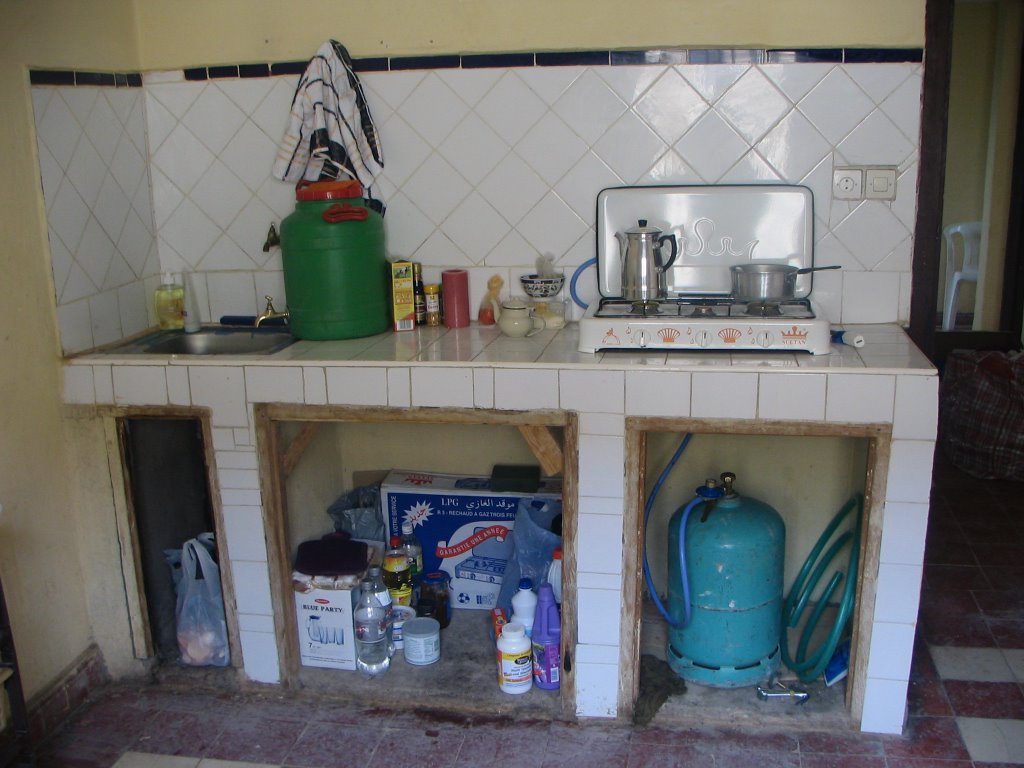
Here’s my kitchen. That big green bottle by the sink is there because I only have water between 5-6pm, so I have to come home then in order to fill up buckets, bottles, etc. Annoying, but I’ll get used to it! Note too the giant buta gas bottle under the counter. Now you can see why I am scared!! I also have two smaller butas – one that I use for light when there is no electricity, and one that is attached to a little camp heater. Nothing like having multiple gas flames going in your house at any given moment!

Of course I still have a Turkish toilet (and no proper shower, although maybe I'll rig something up), but more on that later...

But my favorite part (besides the mattress) is the big private roof! I can bask in the sun, dry clothes, and generally enjoy the view of the nearby mountains, or Assoul’s main (only) street, depending on my mood. I know that some of my friends on the other side of the mountains to the south, in the desert proper, have to sleep on their roofs during the summer, but I am hoping it won’t get quite that hot here at night. (Hard to imagine now – it’s still quite cold!)


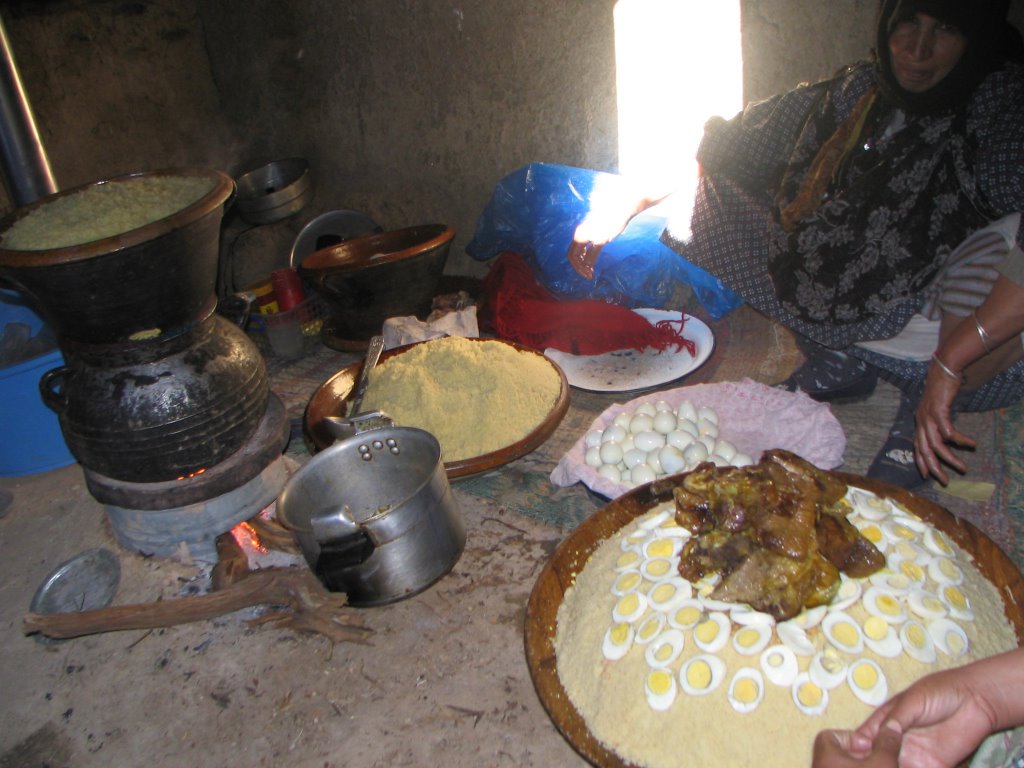
This week I also attended a local celebration of tizlafin. The lunar new year was January 31 (I believe the year 1427 on the Islamic calendar, but don’t quote me on that). Apparently here, on the ninth night following the new year, there is a big celebration for all the BOYS born during the year. As per usual, the women cook all day, giant plates of couscous with eggs (and meat, of course), and at 5pm, men of the house carry these plates on their heads to a central area where they all eat (very quickly) together while a few of the local women and children watch. Of course the women make this into a small festivity of their own, and in the houses where couscous is being prepared, other female neighbors and family members drop in throughout the afternoon to eat couscous, drink tea, and visit. I went over to the house of my host mother’s family early in the day, where I ate a tajine of olives and French fries (yes), then couscous (and meat), and then made myself busy peeling the largest pile of boiled eggs I’ve ever seen, just so I could miss at least a few rounds of eating. Of course I often get angry at the second class status of women here, but then I realize that they have their own little interesting world, and it’s kind of cool, as an outsider, having access to that as well… Now all I have to do is convince them that we American women are not crazy simply because we don't spend hours every morning pounding out bread to bake! (Of course I will admit that, relatively speaking, we are spoiled for not having to do that every day!)

Thursday, February 02, 2006

Back in the big city...

So, as some of you already know, before swearing in last fall, my training class nominated me to serve on the PC Morocco Gender and Development Committee (stay tuned -- funding solicitations coming soon!). Apart from the interesting work, one of the additional "benefits" of said position is that I get to travel to Rabat, Morocco's capital, a few extra times a year for meetings. What a shock to my system, to be back in such a modern, cosmopolitan environment! Suddenly, I felt so much more like myself again! Simply going out dancing or to a restaurant, feeling a little less worried about how to respond appropriately to the unwanted attention I inevitably receive as a female foreigner, and just being able to communicate effectively with most everyone I had to interact with! I think I really must be a city girl at heart...

There is also a little slice of wanna-be America in Morocco's cities called Marjane. Rabat has two of them. I'd heard of it from other volunteers and fellow trainees who'd already had occasion to visit, and rave about all the things you can buy there (especially peanut butter). Basically, this is the same as Walmart, and while it did have an amazing supply of just about everything from food and alcohol to clothes, electronics, and sporting goods (I did, in fact, succeed in my quest to purchase a yoga mat, as mine are currently inconveniently located in North Carolina), I enjoyed Marjane just about as much as I do Walmart. And I didn't see the peanut butter. Truth be told, while I can't get exactly the things I am used to having back home, I can find most of what I need (or a reasonable substitute) in smaller towns closer to where I live. But to be fair, I did avoid the housewares, as I would rather actually get settled in my new home to see what unique items I'll need, rather than go nuts and then have to carry a bunch of stuff back home 10 hours by public transport! Yeah -- and like Walmart, Marjane definitely makes more sense if you have a car! Nevertheless, I am sure to return the next time I am in a city with one, but it sure did feel like a geography warp, and not an especially pleasant one at that!

My other exciting news from Rabat is that, after going over two months and only sitting down on a toilet one time, I actually went over 4 days with nothing but sit-downs! Which actually aren't too fun in the winter, as I was reminded! (Rabat is much warmer than my region, but it's hardly summertime, and the weather was a little unpleasant my first couple of days there).

I am on my way home now, where, in sh'allah, I will pick up the keys to my new house/apartment tomorrow morning! More soon...

Tuesday, January 17, 2006

Lﻉid LKbir

(If you're a vegetarian or otherwise squeamish, you might want to limit yourself to the last two paragraphs of this posting.)

Lﻉid Lkbir – the “big feast” (not to be confused with Lﻉid Lftr, the feast at the end of Ramadan) – this is the holiday I’ve been dreading since before I even arrived here in Morocco. But then, I really cannot complain when I consider the fortunes of others… For the last month or so, every time I’ve crossed from the front door to the front gate of my host family’s house, their large, black sheep, whose girth had been increasing exponentially, would glare at me and begin bleating at full volume. A few weeks ago, I think it finally began to suspect its fate, although it didn’t seem bright enough to do anything about it. After gaining its freedom from its pen, it just walked up to the kitchen window and peered in. After being barricaded back into its tiny prison with a wheelbarrow, it again escaped, and as I opened the door to head out for the afternoon, there it was, trying to push past me into the house. By the week before the holiday, this became a daily occurrence – as soon as someone opened the door in the morning, there was the sheep, as though it would somehow conquer its fate if it could only get into the house while it was still alive!

As for the people, they look forward to the holiday with relish! Ever since I arrived in Morocco, people had been asking me what I would be doing for Lﻉid. This question, among children and adults alike, is consistently accompanied by huge grins and throat slitting gestures. I receive looks of pity when I explain that I do not celebrate Lﻉid back in America.

Over New Years, it was confirmed that this year, according to the Islamic calendar, Lﻉid would take place on Wednesday, January 11, although vacation and other festivities begin a few days beforehand. Monday, my host family and Moroccan friends began making gateaux (this drives me crazy – it’s the French word for “cakes,” but in Morocco it means homemade cookies). On the day of Lﻉid, no one can kill his (because the women do not do the slaughtering) sheep or goat until the king has slaughtered his. For some reason, my family decided to work around this rule by buying a small goat to kill and eat on Tuesday. A little concerned about vomiting (nothing like a little death to aggravate my usual pre-breakfast nausea), and sad to see that this cute (and screaming) little black and white thing was going to have a very bad day, I nevertheless opted to go watch the deed be done, as it’s a level of familiarity that most of us Americans no longer have with our food.

I will say that, while not particularly pleasant, Tuesday ultimately did not turn out to be the carnage that I had feared. With the help of the local butcher, who grabbed the animal and held it down, my host father quickly and cleanly slit its throat. Admittedly as humane as could be expected, and not taking an excessive amount of time, I still had a hard time watching the goat go through the process of dying. Afterwards the butcher began the rather interesting process of skinning it. This takes talent – my host father told me he’d tried once and made a mess of it, taking off too much meat. Here, the butcher cut through one of the animal’s hind legs and began to blow into it, the effect of which is to separate the skin from the carcass. He then skinned it carefully and cleanly about halfway before tying it up by its hind legs near the front gate, where he finished the job. After skinning it, he gutted it, slitting open its belly and pulling out the insides. At this point, I was only thinking of two things: (1) My high school anatomy class where I dissected a cat with an intestinal disorder that rendered it so foul smelling that no one else would work near me and my lab partner, and (2) that I was going to have to eat intestines. This triggered the most disgust in me, because I had to watch the butcher clean them out via a prolonged process of squeezing, rinsing, and blowing. Of course I’d rather they be empty before I eat them, but then I couldn’t help but wonder if it would be any more inhumane to give the animals a mild laxative the day before they kill them. It certainly would be cleaner. (It didn’t help that one of my family’s scary cats went to town on some of the leftovers on the ground later on, and I saw it later behind the house – thinking it was coughing up a hairball only to realize it was in fact puking… blech!). Anyway, the butcher finished and was given the skin and the head as reward for his efforts. What was left was a rather clean looking piece of meat (not as gross as some of the stuff I see outside butcher shops in the cities of Rich or Errachidia).

Having experienced all this Tuesday, I still decided to repeat it on Wednesday, the actual holiday. This time, instead of killing the sheep in the front yard, they took it out into the road in front of the house. We’ve already had one light snow since then, but I think it is going to be a while before I no longer have to dodge pools of dried blood in front of many of our village’s houses. I found this experience much less educational – the sheep took longer to die, and I finally had to walk away to see if my host sisters could offer some distraction. Indeed, Imane decided it was time that she begin showing me her photographic skills (thankfully, with digital cameras, I don’t have to keep copies of her many “abstract” shots). It caught the attention of one of our neighbors, who of course then wanted me to come in and take pictures of her guests in her salon, and during that time, I missed out on what would have been my second lesson in preparing an animal to eat. I think I am ok with that. Besides, when I returned to the house (they did bring it back inside the gate to clean it), the remains of its intestinal cleaning were far more evident than those of the goat the day before. As of this posting, I am still having to dodge that when I come in the gate or hang out laundry.

During Lﻉid in particular, no part of the animal is wasted, and the animal is eaten in a certain order, according to local and family traditions. I’ve also been told (by biased parties of course) that Berbers eat even more of it than other Moroccans. It takes days to finish everything. Now, I’m no vegetarian, but I (and my digestive system) tend to be satisfied with no more than the bare minimum of meat, even with the most harmless of cuts. That can be a problem in this country, where such an outlook is unheard of! I’ll try most things once, but until now, the oddest thing I’ve eaten here has been sheep balls (ok – one ball), which, by the way, are called “tiglay” – the same as the word for “eggs,” which is why you never ask only to buy two eggs at the local hanut (store) or souk. I’d seen intestines and the penis (on the plate, I mean), but so far, I’d avoided those, along with eyeballs and brains – all considered delicacies. I’ve tried bone marrow at a fancy restaurant back in the US, but have yet to adopt the local habit of sucking it straight out of the bones at the dinner table.

Anyway, the week of Lﻉid, as expected, offered an overwhelming amount of meat. I paced myself – probably to the point of offending people, even though I still ate far more than could possibly be healthy. Every meal – all meat and bread. On skewers, in tajines, you name it. I stuck with the organ meat – not sure if I got the heart in there (I was late for lunch the first day), but definitely the lungs, spleen, liver (wrapped in fat – which I’ve had here before), stomach, and intestines. The latter were a bit chewy for my taste, and even though they were heavily salted and cooked with massive hunks of fat, as was most of the organ meat, these were still not rendered completely unrecognizable. And I have to say that it’s the salt and fat that gives my digestive system the most grief… Two things I couldn’t do – first, the head. The hair is basically burned off, and the head cooked and served on a platter, where the meat is simply picked off by diners. The evening this was served in my house, I was, mercifully, still so full from my lunchtime meat (which tended to come in several rounds at every house where I ate) that I had no problem looking at that unappetizing platter and saying “no thanks.” Two days in a row, at two different houses, my lunchtime tajine landed brains in front of me (it didn’t help that the first day, my host brother ran waving the brain at me before it was cooked and asked me what it was called in English). Now, I do intend to try this at some point during my stay in Morocco, but between feeling generally overwhelmed this week and visions of Hannibal, this time I could barely stand to look at it while I was eating.

Lﻉid has offered its other intrigues as well. I learned that traditional henna in Assoul does not consist of intricate designs, but rather you wad up henna in your hands, wrap them up, and (attempt to) sleep. No doubt that my friends and family would take one look at my hands right now and ask what happened, as the tips of my fingers and my entire palms are varying shades of blackish orange. During all the henna and gateaux-making, I’ve enjoyed some colorful conversations with the women in my host family. I find my host cousin Najat – who is often at our house helping to care for the ailing grandmother – particularly entertaining, as she and my (much younger) host siblings, talk relentlessly about the rich, French-Arab man she plans to marry. This time, however, talk turned to me and my prospects. It seems I am now fated to marry a Berber prince who lives in a cave (sorry guys – you know you can’t compete with that!). No doubt inspired by that conversation, on the morning of Lﻉid, my somewhat quiet host mother came running into my room after breakfast carrying a beautiful, deep orange caftan and traditional Berber headdress (like what a Berber bride would wear), saying that I needed to put them on and take a picture to send home! Given that I was still sporting a winter hat and several layers of sweaters and fleece underneath, the only remotely flattering (and not at all like the traditionally solemn Moroccan bride) photo also includes one of my host sisters, who joined us for the fun. Judge for yourself… should I throw away my American wardrobe?

Lastly, the holiday week ended on a rather strange note – a murder mystery in my tiny town. Obviously not a common occurrence around here, but the talk of the town on Saturday was the dead man found outside the Mosque. My host father told me about it at lunch (I had wondered why there were so many people still out on the street when I came back from my run after noon). Because all the women in town had gone to the hammam just before Lﻉid, I couldn’t resist going and taking advantage of its being completely empty that afternoon, and by the time I had emerged, the “local” gendarmes had arrived (they’re 100km away – making my regular visits to take care of my working papers a HUGE pain), and people were lining the main street just watching while nothing happened. It seems, however, not to have been much of a mystery after all -- the main suspect was caught within a day...

Berber Yoga

The days here have been relatively pleasant, provided the sun is shining, but once the daylight is gone, especially when the afternoons have grown windy (which is most afternoons), the air becomes miserably cold. There is little reprieve indoors, unless you are willing and able to practically sit on top of a woodstove or gas heater all night. I don’t yet have the latter, and can only take so much from the former – particularly on nights when I want a little break from family time! So, I’ve had little trouble finding the motivation to do a lot more toning, stretching, and yoga exercises in my room just to stay warm.

My host families both in Ait Hamza and now here in Assoul, of course, have found this highly entertaining (see my posting from back in October for the scoop for my host parents’ acrobatics back in Ait Hamza!). My host siblings now often join me (at least for the things they like) in various yoga poses, or simply fooling around with my exercise bands. My host cousin Najat, who is actually much closer to my age, has on occasion come into my room hurling herself into somersaults or extremely precarious headstands in the middle of the floor. The kids love to get me to do various arm balances (which I’m not all that good at) and headstands on command. That command often comes dangerously soon after a meal or snack for some reason, so sooner or later I fear that’s going to end disastrously!

One of my colleagues – a health volunteer in a neighboring village about 10k down the main road – comes to my village sometimes for tutoring and meetings. On occasion, she’d give exercise classes to one of the groups of women at our local nedi. Unfortunately, she can’t always make it on a regular basis, and as I have already gotten a reputation in town for doing lots of rriyada (exercise), that group asked if I would also teach them yoga once a week (of course, I then also offered the other group of women, who alternate on other days of the week). My colleague had warned me that this wasn’t the most coordinated group of women, and I’d even participated in one of her lessons, so I was definitely prepared to take it slowly. Indeed, one can only go so fast when the only relevant vocabulary that comes to mind quickly tends to be “right,” “left,” “hand,” “leg,” and “look.” Thankfully, there are a few women who have the same limited French skills that I do and who are able to rescue me in moments of greater frustration. In both groups of women, our first class went slowly, with lots of stretching, basic exercises, and simple yoga poses. The group of women who’d already had a few classes with my colleague is a slightly younger group – eager to try things, but also somewhat giggly and ready to play, which I don’t mind, since I think part of the benefit of this is that they get a chance to relax and have fun a bit (that’s certainly one of the reasons I do it!). By our second session, a few of the boisterous ones had no trouble asking me to give them more challenging (and fun!) activities. For example, after trying to correct them two classes straight by showing them the wrong way to do push-ups (sticking my butt up in the air, or smacking down the rear ends of any offending women, brings nothing but laughter), they asked to go one at a time so they could correct each other – it was great (more butt-slapping and laughter)! Later, one woman began hopping around in a squat position, making me and my old woman knees cringe, although I joined her and the rest of the group bopping around the tiny, crowded space where we all try to cram in and minimize hitting or kicking each other. Then, after the same woman began flinging herself up against the wall in a headstand, we went ahead and began to work on how to do them a little more safely! One at a time, I showed them the correct arm position, lined them up by the wall, and helped them get up. Surprisingly, all of them gave it a try, and a few did an amazing job (including one who did one out in the middle of the floor while I was helping someone else!).

Never mind I am supposed to be helping them organize their group and market their products… As an out-of-town visitor to the nedi (who speaks fairly good English) observed, it seems to boost their morale, so for me I suppose it’s just one small thing at a time!

Sunday, January 01, 2006

Happy Head of the Year


... In the middle of a tutoring session a few weeks ago (where I still struggle to learn the difference between the questions "Where are you going to," and "Where are you coming from?" -- those prepositions being among the many radical differences between the language of Assoul and the one I learned during training!), my host father asked me, "What do you understand when I say 'iġf nu-assgwas'?" In one of my more mentally functional moments, I told him I thought he was saying "head of the year." "Right," he said, "iġf nu-assgwas ujdid." New Years. As if I need any strange idiomatic expressions! I get confused enough that sometimes reality messes with my brain even beyond my internal capacity for language dysfunction -- last week, relying on a dash of French and gestures to bolster my comprehension of her Tamazight, I am fairly certain that a woman asked me what medicine I used for my hair in America, because hers is falling out...!

Anyway, Happy New Years to everyone! I'll spare you the indiscretion of my detailed list of resolutions, but you can guess, no doubt, that they include further enhancement of my communication skills (one of my new Moroccan friends actually thinks I am speaking English when I try to use my Tamazight with her), and once and for all purging the excess oil, fat, and sugar that has been surging through my body ever since Ramadan "fasting." My New Years Eve was an uneventful one with the family (my only ride out of town this morning left at 5:30am -- not much space for partying even if social norms would have allowed!). It was our first night with electricity in nearly two weeks, but they promptly shut off all the lights in the house so there would be enough power for the VCD (kind of like DVD, but different format, and unfortunately won't run on my computer without software upgrades) player. We first tried to watch some old Jackie Chan film in French, and then attempted Bollywood with Arabic subtitles after the first failed within minutes -- same result. Disappointed host siblings all around.

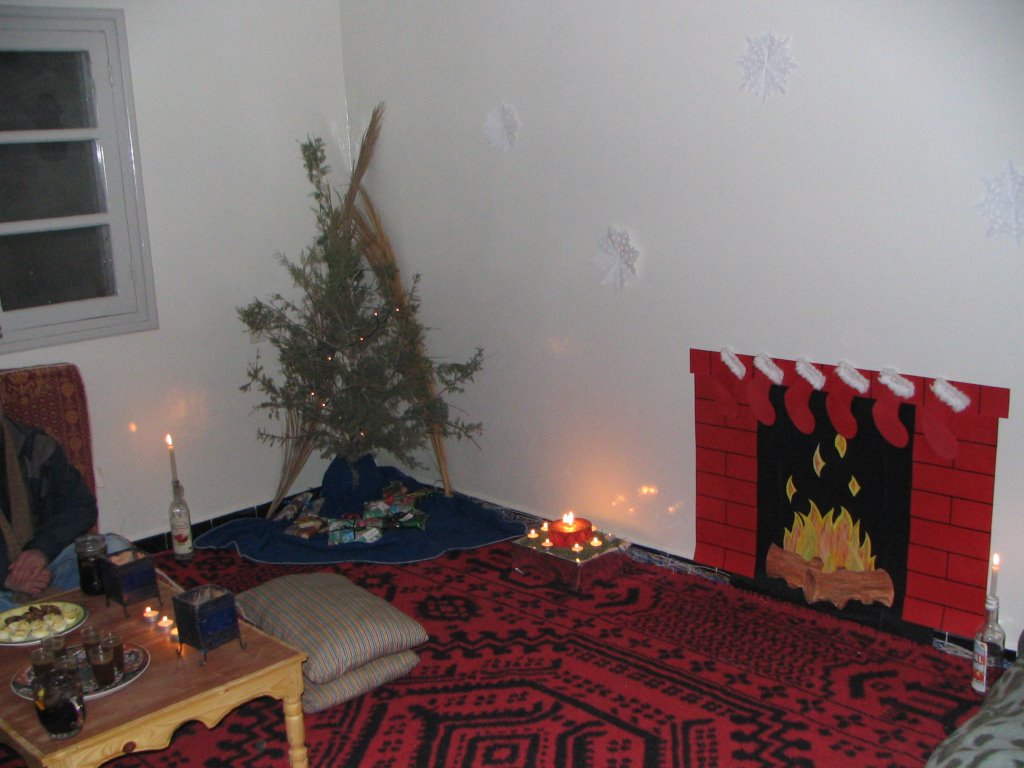
I have also discovered that "Père Noël" visits Morocco too (the big cities even have a little Christmas decor, although thankfully I've been spared that path to despairing homesickness!) ...just a week late. After numerous failed arguments (once I finally realized what exactly I was arguing about!), I was able to confirm officially that no one was going to believe that Père Noël visited me and my American friends and family on December 25, and not New Year's Eve. That said, my apologies (excuses?) for the lack of hard copy Christmas greetings to everyone at home -- my local sunflower seed/greeting card seller didn't have the goods to hook me up, surprisingly enough! But I did have a pleasant Christmas -- feasting twice over at a fellow volunteer's house elsewhere in the region (although given my cooking skills, I mainly stayed on decoration duty, even though the heavy lifting on that was also performed by one of my more artsy colleagues -- here's a picture of the tree pre-trim). My friend even surprised all of his guests with presents and (paper) stockings stuffed with candy, which of course I have already consumed so as to be prepared for the above-mentioned oil-fat-sugar resolution by the head of the year.

I did hear my sunflower seed guy blasting Céline Dion yesterday for the first time in several weeks. With one of the loitering gentlemen out front caterwauling "I'm your ladee... and you are my man..." So often I go down the street deflecting mundane but intrusive questions about where I am going, what am I doing, why did I only spend an hour at the hamman (nothing I do is private for long, although I've used that to turn into a one-woman physical fitness crusade for the village women -- even teaching yoga at the nedi now!), so it took all of my willpower to avoid bursting out laughing in the middle of the street! That was even better than the guy sitting next to me today at the cyber café singing "Barbie Girl" (also not a first). But my favorite pastime lately is tracking the number of little boys I've seen carrying backpacks that say "Rich Bitch." Wow, is my entertainment quotient low these days!

On a final note, one of my friends in the US recently asked me to explain the phrase "In sh'allah," which I know I've used a few times in this blog, so here's the answer I gave her: "In sh'allah" (or any number of spelling variations) means "God willing," and is apparently used by most Moroccans (generally speaking, a fatalistic culture) when referencing any future event, i.e. "I'll return from Morocco in two years, in sh'allah." It's like you don't want to challenge God by assuming anything you plan is actually going to happen. It is also a way people avoid making plans they don't want to make, i.e. someone says they want to go to the US with me, and I might answer "In sh'allah" if it's a situation where a more direct "Ha ha -- no way!" might not be appropriate. Figuring out exactly which meaning is in use (although the former is a safe bet) can be tricky when scheduling meetings, accepting dinner/tea invitations (likewise usually genuine, although -- as we often do in our own culture -- sometimes never followed up with specifics unless you go to someone's house on the spot!).

Anyway, until next time, in sh'allah.

Sunday, December 18, 2005

Miles From Home… And Addicted to Nescafé!

During the few weeks I have been in Assoul, I have managed to keep my days full, although not overscheduled as they were during training. Most mornings I wake up and have breakfast with my host family, pounding several small glasses of fresh heated cow’s milk with half a spoonful of Nescafé. To me, this treat is as decadent as anything I could enjoy at some swanky café at home – who’d have known?!? And I already realize how lucky I am that, as a woman, I also have access to this family sphere. The previous volunteer who lived here, a male, tells me that he’s barely interacted with the women in this house, and that he has never even entered the primary family room (that would be the room containing my new best friend, the woodstove, beside which I rarely miss an evening these days!).

After breakfast, I sit in the sun (my face is going to be leather by the time I leave Morocco!) behind the house, enjoying the spectacular view of the mountains surrounding the valley in which Assoul rests, as well as of the community’s fields, which have been plagued by drought during recent years. Sometimes, I’ll catch up on a little reading – either personal or professional, as I had so little free time for either during training – and of course I try to study the language for however long I can stand it! During that time, my presence alone seems sufficient to entertain the children in the house. Although they’re becoming less shy with me now, the girls in particular – Sana and Imane – seem able simply to stand around staring at me (occasionally giggling, of course) for long periods of time, whether I am reading, brushing my teeth, or most interesting of all, tearing through my luggage for the umpteenth time trying to find my stuff! Sometimes I just smile and giggle back. But they are also gradually becoming my teachers as well – speaking to me more slowly and clearly than many adults do, and sometimes pulling out their textbooks and telling me the words for various objects in the illustrations.

Throughout this time, I’ll also hear the family’s several cats (even by my family’s count, the number is not entirely certain) in the background. These are particularly vicious animals when they feel like it. One day I heard one thumping up the back stairs only to realize it was carrying a dead kitten (no doubt for a snack, as were two pigeons whose feathers I saw on the floor a couple of days ago, although in the case of the latter I was simply relieved that, after Imane and Sana had stood smiling as they held the struggling birds outside of the door to my room, at least I was not the one eating them for dinner. That would not have been an anomaly in this country, where some pigeon dishes are even considered delicacies, but I was not ready for it after having seen my potential dinner squawk and struggle to escape!). One of the cats also makes a noise that will often have me convinced there is a growling dog somewhere in the house. And then I have to be prepared at any time when I’ve left the door to my room open for two of the animals to come tumbling in, tearing at each other as though it will be a fight to the death. They already realize that I’m not too keen on physical abuse, so any efforts I make to get rid of them are usually in vain.

So when all that household excitement gets to be a bit much for me, I may go for a walk, run some errands, or visit the office of the community association to whom I report (when I can find the president around). I have recently been reading Living Poor: A Peace Corps Chronicle, Moritz Thomsen’s reflections on his experience as a Peace Corps volunteer in Ecuador during the 1960s. Of course it is a different continent, and no doubt significant aspects of the generic “Peace Corps experience” (if such a thing ever existed) have changed since then, but one thing that he describes of his early days I can relate to quite well: sitting through meetings and social conversations in this language that I barely understand, and simply having my brain shut down. No matter who I am or what I have done in life, for all practical purposes, here, I am a moron! Nevertheless, I am lucky that enough people are patient with me and that, thankfully, this is a culture where greetings alone can go on for more than ten minutes it seems! Even though I’ve never been one for extraneous conversation, and I still struggle to accept the social value of such redundancy (intellectually and culturally, I get it, but it goes against every fiber of my personality!), at least I can hold my own for a few minutes of “Labas? Labas. Kulshi bixir? Labas... L’Hamdullah.” (And maybe a “Sinnag ras shwiya Tamazight!” for the benefit of those people who commend rather than criticize me for what little Tamazight I do know!).

During the afternoons I spend a few hours at the community nedi, the women’s educational and craft center that I have been charged with assisting. At this point, I am simply trying to get to know the women a little better, and increase my capacity for communicating with them. There are sixty-four members total, who alternate attendance days because the building in which they work is so small, and an additional waiting list of forty more. That’s a lot of names to learn when I can’t even remember the language (besides the fact that name recall is not one of my stronger skills even in English)! But they help me out a little, teaching me new words, often related to the various forms of tissage in which they work (mainly knitting and embroidery, although there is also some weaving and crochet), while I review some of my PC-issued manuals or, when my brain can’t take that anymore, work on my own cross-stitch project (no doubt at this point some women think I am only here to do that though!). But there are many possible organizational projects for this group, and I can’t wait until I am better able to get a start on all that!

I have tutoring sessions a few evenings a week with my host father, who is an excellent teacher with a healthy respect for my obsession for understanding grammatical structures. But every day when the sun sets, and the cold air immediately sets in, my host mother Fatima (a woman only two years my senior whose temperament reminds me a lot of my friend Val back in NC) treats me to another pot of warm milk with a jar of Nescafé sitting beside it, and to me, everything seems right with the world, whether the electricity Is going to come on that night or not!

Thursday, November 24, 2005

Happy Thanksgiving!

A quick hello to wish a happy, warm holiday to those of you with whom I haven't yet corresponded this week!

Last weekend, I said my final, sad goodbyes to my host family in Ait Hamza. A few days later, after a language test, more training sessions (as if I weren't scared enough of the buta gas tanks everyone cooks with here, they had to scare us more!), and a fun mock wedding ceremony with amazing live Berber musicians, my fellow small business trainees and I bade farewell to our little Auberge in Azrou, and headed to the town of Immouzer. This town, less than an hour away from Fez, feels quite suburban, and the vegetation and landscape here appear much like any US town in a slightly mountainous area. Here we joined our youth development colleagues at what first looked like a country club compared to our home in Azrou -- a compound with outdoor spaces, a basketball court, pool table... -- although now I think that impression was highly superficial. I especially miss the owner of our Auberge in Azrou, who was so kind to all of us (he even gave me a beautiful blanket for my birthday, back when he had barely gotten to know any of us)!

Today we officially completed our training, and I am eagerly awaiting a yummy Thanksgiving dinner this evening with 50+ of my newest friends! Tomorrow is our official swearing in ceremony in Fez (too bad they whisk us in and out before we really get to explore anything!), and in spite of my underachieving efforts to prepare for my oral language exam last Sunday (in order to avoid any additional work this week), it appears that I have been commissioned to deliver a speech in Tamazight tomorrow during the event, in front of the U.S. Ambassador, our host families, and everyone. That should be entertaining (and short), to say the least! But with my cape (a gift from my host mom), scarves, skirts with pants underneath, and fingerless gloves (it's gotten to be strictly utilitarian dress these days), I'm certainly getting crap from my colleagues that I'm turning into a Berber woman already!

That's it for now. I leave for my site (which will take two days) on Saturday, although much of the next week will be spent running errands in the cities of Errachidia and Goulmima. (Frankly, my primary anxiety is about the agony of moving all of my luggage around, since Peace Corps has given us so much additional gear and books that I now have another entire large souk bag full of stuff!). Anyway, it looks like I'll hardly be getting settled any time soon! But now it's time to go eat a little bibi!

Wednesday, November 16, 2005

My new home...


Well, I finally learned where I'll be living the next 2 years, and spent the better part of last week exploring the area, getting to know my new host family, job, etc. -- how exciting!

I am going to be in the High Atlas village of Assoul. As usual -- not in the guidebook and only on a really big map. There is only one "transit" a day in via the closest town. The only other way in and out depends on when the road is passable (not last week, for example!). I have no cell phone service, which will make work a little challenging (we all already knew I'd have to travel out of town for Internet!), and perhaps sanity even more so as I now have to wean myself from my newly-acquired texting addiction. There is a PC health volunteer there working to bring latrines to the area, as only a fraction of houses have any sort of toilet, and the town operates on a generator from 6-10pm each night, with houses alternating 2 nights on, one night off!

Sounds like BFE? Yes, but so far I love it! The drive in is stunning -- perhaps even my new favorite! My host family seems wonderful -- they've hosted a volunteer before, so they seem far more willing to let me be myself than what a lot of volunteers face, and perhaps just as importantly, it doesn't look like I'll have so many dinner table power struggles as I do in Ait Hamza! My host father is fluent in English, as well as (of course) Tamazight, French, and Classical Arabic, so I'll have no trouble getting tutoring in whatever I want/need! I am working with a women's group called a nedi, which does various forms of "tissage," including weaving, embroidery, and knitting. I am glad for the variety, and there are also a lot of potential projects with the group, so I won't be lacking for ideas going in. The harder part at first I think will be simply prioritizing needs. And this is all happening under the oversight of a community association which is highly organized and dedicated to community development projects in education, environment, and health. It's a windy place, facing a bit of a drought -- plenty cold in the winter and hot in the summer, but none of the extremes possible in this country (Azrou, BTW, is f-ing freezing now, and I even had to drive through snow heading back!)

I wish I had time now to go into all of my little (mis)adventures during this trek, which included stops through the provincial capital of Errachidia to meet my government supervisor, and the town of Goulmima, where I'll be spending a bit of time during the next few months with gendarmes trying to finalize all of my working papers. And there was a transit breakdown in the middle of nowhere and a minor bus crash... but this is Morocco and I'm ok, so it's all good!

Just a week of training left. I'll be leaving tomorrow to say goodbye to my host family in Ait Hamza; language test on Sunday; next week off Immisour (I'm sure I'm spelling that wrong) to celebrate Thanksgiving and then to Fez to get sworn in!

Sunday, November 06, 2005

Safi sHur


Just got back from 2 more weeks with my host family in Ait Hamza – a place never wanting for adventure, as small as it may be. My host family remains wonderful, but I can see how, on some counts, my standards are quickly dropping. First, I have fleas. More fleas than last time, I mean. And I only had 2 “baths” in 2 weeks – but that’s more than a couple of my fellow trainees there enjoyed! I’m beginning to see additional benefits of head covering now! Oh – and the livestock! My “school” (part of a house our instructor rents out) has an outdoor Turkish toilet, which, while it continues to afford a slightly better sense of privacy than the toilet in my homestay, still has occasional visitors. Twice I had to chase out chickens during times of intestinal distress (and twice a little girl who seems to enjoy watching me in there)! One of the landlord’s chickens also seemed to have a favorite spot on a ponge in our classroom, where we found it (and of course its droppings) a couple of mornings… I can’t complain though – one of my friends had a donkey walk in on her in the toilet at her house in the middle of the night! As for the toilets, well, since the only way to get rid of paper waste is to burn it, I find that, provided there is some water available, more and more I’ve been doing things the Moroccan way (e-mail me if you require clarification – I’m trying to keep this clean!).

Ramadan actually ended this week with celebrations of Eid. I made it through with the fasting, apart from cheating a few sips of water a couple of times when I was sick (when, technically, you don’t have to fast anyway, nor while you’re having your period). But it wasn’t the fasting that ultimately was killing me, but rather the 3:30/4am meal of sHur. That was tough enough at the Aubèrge in Azrou, but at least there it was just a little bread, yogurt, and fruit. But – and even though I knew to expect this, it was still a bit overwhelming – many families here actually prepare full-on meals in the middle of the night. In Ait Hamza, that usually means bread and a greasy tajine full of lamb fat and Allah knows what other body parts. As much as I usually like a good piece of lamb, this was not it, and of course the general nutrition of this diet (coupled with all the sweets of lfdur, the meal you have to break the fast in the evening) is somewhat lacking. I tried to go along with it the first few nights, but couldn’t help but get sick from it, and finally had to start asking to eat mainly fruit, and occasionally just to sleep through the meal. Unfortunately, this is a culture that seems to think that if you are sick, you either need to eat more and/or wear more, so it was hard not to disappoint my host mother – who is definitely a strong willed woman – in explaining to her that I needed a break sometimes, or even simply that I preferred to sleep! I may just tell my next host family that I’m a vegetarian.

And I didn’t get much sleep. Most nights we had lfdur at the home of one of the trainee’s homestay families, which often extended into iminsi, the 10pm-ish dinner. And by about halfway through our stay in Ait Hamza, our late nights were getting pretty filled up as well… (and don’t forget we had classes every morning – even Saturday!). After we’d been there a week, a couple of us were begging to go to the hamman, the public bath (the lone guy in our group had been taken there by his family earlier in the week). Since Ait Hamza is pretty small, there is only one hamman that is scheduled for men or for women at different times of the day. Because women are usually allowed there in the morning, when we had our language lessons, plans were made to open the hamman especially for us Saturday night, after the men were scheduled to leave at 10pm. Of course all the other women in town decided to take advantage of this opportunity as well (and no doubt were a little curious to see the Americans), so the bathing turned into quite an ordeal! I got scrubbed down (to the point of losing skin, as is the norm) several times, and was still exhausted and ready to go after an hour or so. Especially in the innermost room, it’s VERY hot, and who wants to keep sweating when the point is to clean up! But, of course, the point is to socialize, so even when my friends and I had finished, we waited around for our families until around 1am. To me, the most irrational thing about the hamman is that even though you’re in this room full of women scrubbing each other down front and back (ok guys – whatever image you have here, you should trust me that most of these bodies are not ones you’d enjoy looking at), the one piece of clothing you keep on is our underpants. Which weren’t clean to begin with, and now you’re sweating in them more!

The next morning, I went to the souk at the nearby town of Guigou with my family. It was huge – big enough that people come all the way from Azrou (the much larger city that is my other home during training) – and had just about anything a Moroccan could want for his or her dinner, home, or farm. Peace Corps of course compensates our families for our meals, so I took advantage of that, as well as the fact that my host mother seemed to have it in her head that I hadn’t eaten all week (in spite of the fact that my stomach was exploding!) to beg for a couple of vegetables – cauliflower (yum, and they’re gigantic here) and tomatoes. And the souk is also a big social event, so we were there for several hours, in the dust and wind… So much for last night’s hamman!

That night marked the 27th day of Ramadan – when the Koran descended to the Prophet. It is a night when Muslims are supposed to pray all night, reciting the Koran in full, although the reality is that they come and go from the mosque when they need some rest. I was told that elsewhere in Morocco, people take breaks for meals while they are at home, but in Ait Hamza, the women actually bring food to the mosques (there are two) to feed their praying family members right there. In Ait Hamza, the women are also allowed in the mosques to pray – at least on special occasions like this – so even though I was with some trainees at someone’s house, enjoying couscous (which I learned a little more about how to prepare) for the holiday (it’s normally served only on Fridays or special occasions) and just hanging out, as it got later, no one could seem to find my host mother to escort me home, so that turned out to be a rather late night as well!

The following night was the most exhausting of all. Although during my previous stay, I had been taken to pay respects to one new mother, the big celebrations of birth are actually on the day of the baby's birth, and the naming ceremony, the naming ceremony, or ssabia, held seven days later. For this, I was loaned a caftan to wear, and paraded to a house full of women singing, playing drums, and drinking tea. My instructor's landlord, Fatima, was the life of the party, drumming, singing, and dancing, and I continue to be amazed by the lungs on the women here. I'd been warned about all the activities by a fellow trainee, who was on her second ssabia in a week’s time, and sure enough, as soon as the dancing started, she and I – as part of the American circus – were the first people dragged in front of the group to try to shake our hips the way only Berber women can! While it was a lot of fun, I have to say this was also an extremely physically uncomfortable experience, as by then the group of 60+ women had moved into an even smaller room with no ventilation, and with a buta gas (big tank full of gas used for all cooking, etc. purposes – very scary) running to help heat up the drums. I was crouched in a corner with 3 other trainees sweating like crazy thanks to our polyester caftans, drinking hot tea, and the general body heat in the room. And then the food started coming. More sweets, as always, and after several more hours of dancing and snacking, the hard-core musicians left the room while the rest of us were served tajines of lamb that had been slaughtered for the event, and then couscous (approximately 1am). I really admired Kenza – one of the women I’ve gotten to know through the weaving cooperative – who sat next to me and rolled perfect balls of couscous with one hand. I still drop it everywhere, and take full advantage of spoons when they’re made available for the couscous. Everything else – tajines etc. – I’ve gotten used to eating with my hands out of a communal dish, as I did in people’s homes in Ghana. And anyone who visits me ought to be warned – I find this a fantastic way of minimizing dishwashing!


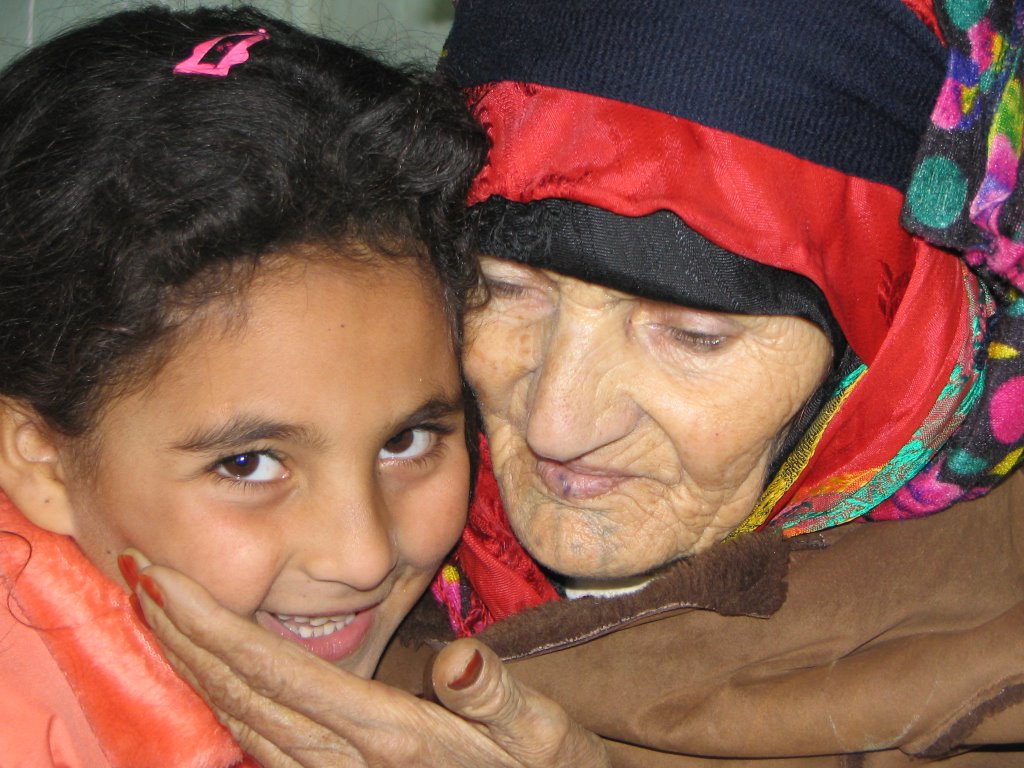
Like the beginning of Ramadan, the exact date of Eid, which lasts for 2 days, is unknown until the moon marking the end of the month of Ramadan is observed. The night before, many women have henna done on their hands and/or feet – and mine was beautifully done by one of our 15 year old neighbors! Like last time, I was then expected to eat and sleep with all that stuff on my hands, but the result is worth it if you don’t screw it up before it dries. Some people continue to fast for those two days, although others return to a “normal” eating schedule on the first day of Eid. Like the rest of the month, there is a festive air that reminds me a bit of Christmas (during Ramadan afternoons, my family played holiday music and baked), and as we sat down to our first daytime breakfast (also called lfdur), children kept coming into the house and kissing me and my family in exchange for a handful of cookies or cake (which reminds me – in spite of all the sugar I’ve been consuming, I really missed the candy corn this Halloween, if anyone wants ideas for care packages after I get a mailbox!). I spent much of the day paying visits to neighbors, and also observed a little holiday spat between my host sister and her parents – so I guess some things about holidays are universal… The following day, we had practice interviews with our language instructor (we all get tested before Peace Corps swears us in), and burned trash for the second time during our stay, but the holiday continued back at home, where I had couscous for lunch, and met even more of my extended host family, many of whom are also named Itto, like my mother, and including two of my mother’s aunts (one with awesome Coke bottle glasses who showed off her full set of gold teeth!) who were the cutest little old ladies ever! We’ve also spent a lot of time with a neighbor named Rahkia, an old woman with only two teeth whose greeting of “labas?” sounds more like “labath,” so I’m never going to understand her… but she loves me (not as much as she loves one of my blonde colleagues though!), and just stares into my face smiling and saying “labath, labath” over and over again because I don’t know what else she’s saying.

So that’s the overview of my last two weeks – even with a journal and a notebook, I bet I am forgetting a lot (as well as censoring a few interesting points with which I’ll tease you into staying in touch!). For example, one person in my group swore her family gave her gunpowder to eat when she had diarrhea, although I think we figured out later what really happened there…

My family has been wonderful in helping me learn the language, and between them and classes, this has been an incredibly intense experience (although as much as we’ve learned, I remain barely functional in real life, and I have to remind myself that I’ve only been studying Tamazight for a month!). Dad is still most likely to give up and use French, although I like that practice too, and having that in common certainly has been useful in getting him to run interference for me at the dinner table. My host mom is a unique woman, but I know she is trying hard to make me happy, and I can pick up enough language to know that she’s been proud to take me to visit other people and tell them how much she’s helped teach me. My host sister is the best though. She speaks fairly decent French (definitely better grammar than mine these days) and is just starting to learn English, so she is definitely the most empathetic and patient when it comes to saying things slowly for me and trying to understand my accent. I’ll be interested to see what happens to her in life. At 14, she’s already traveling to Guigou for school, and I can see that, although the family makes her work very hard around the house as well, my host father places a lot of importance on her education, as does she. She already travels to Guigou for school every day, and to me she stands out, even among her friends and other girls about her age, as being a little less “Berber” in her dress and demeanor. Generally, she’s more outgoing, even with guys, and I’ve never seen her walk around in pajamas or bedsheets, as is the fashion for most of the Berber women and girls I’ve met both in Ait Hamza and in Imilchil. I’ve enjoyed helping her a little with her English (and of course that’s a mental reprieve for me as well), and she’s much more willing than my mother to let me actually participate in the kitchen (probably because it’s helping out with her work) rather than having me sit on a stool and watch.

Speaking of watching, Desperate Housewives was on the other night. Even with a little editing, I was still quite surprised to see that in the midst of all the Ramadan specials (short-run soap operas and comedies; the religious programming was on another channel, which I think some families watch more diligently than others). Some of the non-holiday programming was in French (usually dubbed), but all of this is in Darija (Arabic), so it’s not helpful for me to practice either French or Tamazight. Personally, even if I understood Arabic, it drives me crazy to sit staring in front of the TV for too long, so I’d often make an escape to read, nap, or study in the evenings when the TV got to be a bit much. And rude as it seems, I finally started carrying something to read on visits, in case I got stuck in front of the TV there (because if it’s not the TV, of course it’s people quizzing me on the language or each other’s names, which I’m not even good at in English!!!). There is a Moroccan newscast in French around 9pm, which I can understand reasonably well when there’s minimal background noise, but my main sources of American news are week-old Newsweeks, courtesy of the Peace Corps, and text messages from trainees in other sites that have Internet access…

And in the midst of all this, we did spend more time talking shop with the local weaving cooperative, and have made progress on some of the things they can do to improve their situation. Compared to other things I’ve seen in Morocco, their products are very high quality, as they’ve already benefited from other outside assistance and training. The primary problem right now seems to be their general fear of competitive markets, even while they’re hoping to find a market outside of Morocco. But the bottom like is that they need to get more consistent experience here too! In any event, to be just over two years old, this cooperative is amazingly organized, and the volunteer who is ultimately assigned here will have a lot to work with!

Tomorrow I’ll find out my final site assignment – could be Ait Hamza or could be something new. And the very next day I’m off on my own for a week to scope it out!

Sunday, October 23, 2005

Field trip to Imilchil


Greetings from (my brief moment in) civilization! I returned from the Berber village of Imilchil on Thursday. Located farther south in the Atlas Mountains, Imilchil is fours hour transit from the nearest town of note – a stunning drive (particularly by sunrise, as I enjoyed during my return trip) on a crowded van through arid valleys. Although it is an extremely small town, with no electricity (there used to be a generator, but it broke some time ago) and running water only for two hours each morning (lots of fun filling bottles!), it actually has more traces of civilization than my homestay site in Ait Hamza – including several small hotels and a souk (market) on Fridays and Saturdays. This is because Imilchil is a bit of a tourist draw, due both to its mountain location and its annual marriage festival.

Legend has it that long ago, a young man and a young woman from two warring Berber tribes fell in love, but their families would not let them be together (a little Shakespeare, anyone?). Because they could not be married, each wept so hard that two separate lakes were formed from their tears – Lake Isli and Lake Tislit, the latter of which I visited during my stay. Each year in commemoration, near the end of summer, there is a large festival where, traditionally, various tribes come together for women and men to choose their spouses. More recently, of course, this festival has become more of a tourist attraction, with engagements being established, but also enjoying a range of cultural events, including a craft fair.

The primary local craft is weaving in the traditional tribal pattern of Ait Haddidou – simple colored stripes in black, white, and a deep red. The women of the village have recently formed a weaving cooperative with the help of a local Peace Corps volunteer, although they continue to work only out of their homes at this stage of their organization. I met with a couple of women in the cooperative while I was there, and viewed a range of products from traditional winter capes for men and women, to more experimental efforts at designing purses.

While in Imilchil, we were invited to lfdur – the 6pm breaking of the Ramadan fast – at a couple of homes. This is always an elaborate spread, taken as soon as the dusk call to prayer is heard, consisting primarily of dates, various sweets, breads, soup, and either tea or coffee. It’s a dangerous thing for those of us who work hard to stifle our sweet tooths, as it includes local specialties such as a fried honey pastry called shebbakiya – one of those things that is simultaneously disgusting and addictive. I can feel my teeth rotting!

We also hosted a group of teachers for lfdur one evening (cooking by candlelight and unpredictable gas ovens is quite a skill in itself, I am learning!). The teachers here are assigned by the government, not surprisingly according to seniority, so that many of the youngest – however cosmopolitan their backgrounds – end up in rural areas. Interestingly, none of the teachers we met spoke any Tamazight, yet that was the only language of many of the students they taught! It made me think of the bilingual education debate at home, although here the situation is faced not by immigrants, but by local children. Also, because the country uses a standardized curriculum, these children who have lived their whole lives in a remote mountain village with no electricity are often reading books with foreign references to things like beaches or the Internet! All the same, I was amazed by the level of education of some of the young people I met, and it made me wonder at the disconnect it must create – particularly in villages, unlike Imilchil, where there is no exposure to foreigners and tourists.

My own language skills continue to be a mess! Two weeks in Azrou – where the fasting for Ramadan had become my excuse to nap at any given opportunity – had rendered me a bit lazy on the studying front. When I got to Imilchil, of course the dialect, and some of the vocabulary, varies a bit both from the dialect spoken by my trainer and from the one my host family in Ait Hamza speaks. The upshot is that now I know that no matter how much progress I make in the next month, I’ll still have to relearn everything when I get to my final site! I pick up bits and pieces of what’s said to me, but still feel like I have no capacity to respond (not to mention my pronunciation is still all over the place!). I know it will come – I am amazed to hear other volunteers who have only been here a year – but for now I think that remains a source of anxiety for myself and for many of my other fellow trainees!

Generally, all is well, and I am preparing myself for the likelihood of a rather rural placement, given my recent assignments, but I’ll find out about that in about two weeks! While the amenities may be lacking, I think there is a bit more security in a rural site, although the attention is simply different (from people yelling out your name – everyone here calls me Najia, the name given to me by my host family – to little girls wanting kisses or tearing hairpins out of my hair, to little boys who alternatively test their Western language skills on you or simply throw rocks…). I’m also getting more used to navigating the Turkish toilets and infrequent bathing, although at least there seems to be a hamman (public bath) most everywhere! Things have been a fun so far, but I really am feeling ready to get settled somewhere (hopefully a little warmer than Imilchil!) not too long from now…

Sunday, October 09, 2005

Ait Hamza


Mbruk Ramadan!

I have recently returned from my first week of community based training in the village of Ait Hamza, which was quite a change from our training activities in Azrou. Ait Hamza is located less than an hour away from Azrou, but it is an entirely different universe, as we quickly discovered after checking in with the Caid and gendarmes at the slightly larger nearby town of Guigou.

In many ways, Ait Hamza remains quite primitive – its population is approximately 2,000, although I’d have guessed about half of that… Apart from the weaving cooperative with whom our group is working, the town’s primary source of income is agriculture – wheat, barley, lentils, onions, or potatoes, depending upon the season. The women in particular lead hard lives, working in the fields, taking care of their families, and weaving (many of the village men are military or retired military; if they work locally at all, it is in one of the village’s few shops). The cooperative has a membership of about 75 women, 3-4 of whom are literate. They are currently working in a building that is not large enough to accommodate the entire group, so many only work from home.

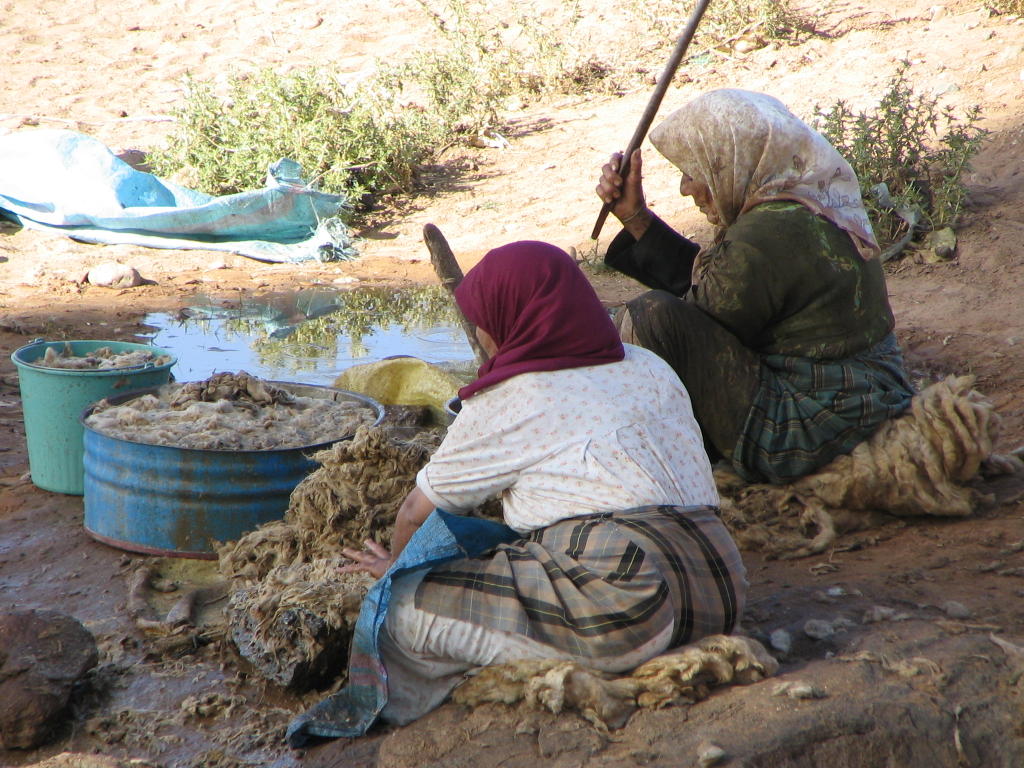
Throughout the week, I was able to observe the women working at the looms and performing the difficult process of beating and washing out wool in the river. We also spent a bit of time speaking with them and learning about their work. There were many fine meals and snacks, and exposure to local culture which included hearing some traditional Berber musicians perform at the house of one local family following a henna party and dinner (which was hard to eat – done by hand from shared dishes – with all of that stuff on my hands!). Some members of the community are better educated, and these were often my window to understanding what was going on around me, although in most cases I knew that, as the American, I was the main event during social visits, when accompanying my family to the local tahanut, or simply walking down the street.

I am staying with a family that is small by any standard, especially Moroccan – with mma Itto, baba (Mohamed), and their 14-year old daughter Fatima, who goes by Mouna. Their house is modest, with only 3 rooms, and I felt a little uncomfortable that I was given their salon – by far the nicest room in the house – to stay in. While they do have basic infrastructure – electricity and running water – managing simple daily activities such as washing in the one sink in the house (in the kitchen area), or using the WC (or bit lma – a Turkish toilet located in a barely private walled off area) took a bit of strategic planning! As for Ait Hamza in general, there’s not a trash can to be found (that I know of), and my fellow trainees and I decided simply to burn our rubbish a couple of times during the week! Bathing involved an elaborate affair (only once) of setting up a hammam in the bit lma using tarps and buckets of hot and cold water…

Mma Itto is a weaver by trade, currently vice-president of the local cooperative. She keeps one loom at home where she is currently working on a vibrant piece incorporating the Tamazight alphabet (which to me looks almost hieroglyphic, and not at all like the Arabic script), and she also works over in the cooperative at various times during the day. Like many of the older women in the community, she maintains a more traditional Berber identity, speaking only the local dialect, and sporting tribal tattoos on her face. The day we met, I believe she was genuinely shocked that I really did not speak her language at all (those few words of Tamazight greetings I learned beforehand didn’t go too far, especially with my accent!). So we took a long walk which consisted of my asking the names of various natural and agricultural products. Mercifully, baba and Mouna speak a little French, so we were able to bridge any critical communication gaps by fumbling through that, and of course Itto seemed ready to grant unconditional love to her new daughter in spite of the fact that our conversations – especially during the beginning of the week – consisted of little more than my attempting to repeat everything she said to me until she was convinced I truly had no idea what she was saying! Thankfully, by the end of the week, I’d picked up enough basic phrases and grammar to get some sense of things contextually, and of course our intense language study has continued now that we are back in Azrou.

Itto, baba, and Mouna are a unique family. Baba is actually the security guard at the women’s cooperative, but when he is at home, he helps out with minor household tasks far more than I would have expected, and indeed far more than I have observed of men in other homes. My family also keeps a pet cat which, contrary to what I had read about the relationships between Moroccans and their pets, they – especially baba – treat like another member of the family. (The downside is that the cat loved getting into my bedding and clothes, so I am not exactly sure what sort of infestation I have brought back to Azrou with me, although that does not seem to be an uncommon affliction among my fellow trainees!).

In many ways, I feel like I might as well be sitting in a home in middle America, with only the environment itself being different. We sit around a table, on the floor, in the cramped family area, where there is a TV and where Itto keeps her loom. During our evening “snack” and dinner, we watch TV, including Egyptian soap operas, local news in Arabic and French, what looks like an Arabic version of the “People’s Court,” and a French-dubbed “Married With Children” (with a startling break in the middle while the evening call to prayer is broadcast). Manu comes and goes with her friends, getting help from them and baba with her homework. I’ve tried to convince her that my French isn’t so good that she should be asking for my help with that, but she is also just starting to learn English, so I’ve given her a little help with that, in exchange for her fairly intense efforts to improve my Tamazight pronunciation. She is quite happy to get in my face and yell until I get it right, which actually does help!

Ait Hamza is so small that it’s hardly a 10 minute walk between the most distant buildings in the village, but I did try to get in a little exercise there, much to the amusement of my family and myself. One evening Itto walked into the salon to find me using some exercise bands. Lacking the facility to explain what I was doing, I did a couple of simple curls with my band and then handed it to Itto, who began pulling and curling until, suddenly, she threw her arms into the air and dropped into a split! Then she went out into the family room and apparently told baba what I was doing. When I came out, he told me he has also practiced some yoga, demonstrated a nice standing forward bend, and then also dropped down into a side split! Needless to say I hoped I’d found some new way of communicating, and invited Itto to join me for some yoga again the following night. Unfortunately, we didn’t get too far, as she began giggling uncontrollably about two steps into our sun salutations! At least now I know that when I need a little alone time, I can point at my room and say “yoga,” and I think the family understands…

In spite of my efforts, this is generally not an active lifestyle, apart from the women who endure more difficult labor in the fields, cleaning wool, etc. In fact, there is a lot of sitting around, socializing, and eating. The first night, I wasn’t sure if the 6pm meal of eggs, bread, cake, tea, and zmmita (a delicious crumbly paste of flour, nuts, and spices) was a light Moroccan dinner, until I was lead to someone else’s house to be fed a rather large dinner of tajine and couscous around 11pm (the women are often fed last). That in fact turned out to be one of my lighter eating days – most of the time the evening snack consisted of far more sweets, and usually was taken at multiple houses as visits were paid (I actually experienced some nasty caffeine and sugar withdrawal headaches upon my return to Azrou). All meals become a challenge of finding the right way of convincing your host that you really can’t eat anymore – using a succession of phrases ranging from more mundane statements that you are full to thanking Allah for his blessings as an indication that, as good as the food may be, you’ve had enough. Unfortunately, it appears that I haven’t yet learned to say those with sufficient authority, although I think some of my colleagues had even more problems with being overfed than I did!

The contrast between that and being back in Azrou, where my food intake is not so closely monitored, is even more overwhelming as Ramadan began on Wednesday of this week. I decided to see if I could fast for the month, in an effort to better appreciate and respect the local culture, as well as simply to enjoy more fully the evening lftur, or breaking of the fast (talk about lots of sweets!). The first day or so was not so easy, but even here at the Aubèrge there are other trainees giving it a try, and of course the staff has altered the meal schedule accordingly. So especially during those 4am eating sessions, it does feel like there is some support from the group. After the first day, it hasn’t been as hard as I expected (in the end, we still eat plenty – it’s just that the schedule is backwards), although I am well aware that a month is a long time, so hopefully I can see it through! Frankly, one of the hardest things was simply the anticipation the night or two before. While I knew that the holiday is based on the lunar calendar, thereby causing the dates to shift every year, I hadn’t realized that we wouldn’t know in advance exactly which day the holiday starts until someone in the Moroccan desert sees the new moon and notifies the Ministry of Islamic Affairs. As such, I had a day or so where I wasn’t sure exactly when I was going to have to stop eating. But of course the announcement was made the night before, and that first morning we were woken up to eat at about 3:30am by a trumpeter on the street. We have until the call to prayer between roughly 4:30 and 5am to eat one last time. It works fine at the Aubèrge, where we’re fed another dinner around 10-11pm, but it will be interesting when we return to our homestays later in the month. Some Moroccan families stay up the night eating and celebrating until the morning call to prayer – how exhausting! (Of course people here tend to take a lot more time resting during the day during Ramadan, but I still have language classes, etc. to synthesize, which is hard enough when you’re not loopy from hunger!)

All in all, I am looking forward to my return trip to Ait Hamza later in the month, when I can celebrate Ramadan with my family and have a little more to say to them in their own language, in sh’allah. But for now I have a few more days to enjoy the comforts of Azrou (they even have Peanut M&Ms here!!!) before I leave to spend a week with a volunteer in the even smaller and more remote village of Imilchil…

Sunday, September 25, 2005

2 weeks...


Greetings from Morocco!

So far, my days have been filled with learning and excitement over what the next two years will bring! (Ironically, this has at least started out as the most sheltered of all of my travel experiences, although of course that has already begun to change!). I am currently in the middle of a training process that will continue until I am sworn in the day after Thanksgiving, in sh’allah!

With a group of 52 other small business and youth development trainees, I arrived in Casablanca on the morning of September 13, and from there took a bus to Rabat, where we were more or less under lockdown (from what little exploring l managed, it had the feel of most other big cities I’ve ever visited). After a few days of preliminary training information, about half of us (the small business development trainees) traveled to the Middle Atlas town of Azrou. This is a large town of about 50,000 – a pleasure to be in with a little more “personality,” but retaining all the conveniences. We still don’t have a lot of free time, but manage to venture out periodically. One walks the streets to see numerous vendors, the occasional bakery or cyber-café, and hoards of men sitting at cafés everywhere surveying the passers-by. Of course the women are conspicuously absent from the café scene – and indeed my only attempted venture to a “women’s” café with a few other women landed us at the Café Afrique, which turned out to be at a gas station (albeit one with a lovely view!) on the extreme north end of town, far away from all the city bustle or even the more “suburban” homes! In any case, the men at the cafés in the city all look bored silly, so I don’t think we’re missing out on much (this has actually been confirmed by a couple of my male colleagues). I’ve already had a chance to visit the local artisans cooperative, to begin to get a sense of the type of crafts I might ultimately be involved with, but probably the most interesting thing I’ve stumbled into so far has been a circumcision celebration on the street as I was returning home with some friends a few evenings ago. Because we are now in the mountains, the weather is dry, and often rather cool at night – which has made for some pleasant sessions of rooftop yoga and Pilates at the Auberge which is our on-again, off-again residence of the next couple of months.

Our days are quite full, with 4 hours daily of language training and Arabic script (which is pretty cool, even though I still feel like a 5-year-old who shows up at kindergarten being asked to write in cursive right away!). I spent about a week learning Darija, the local Arabic dialect, but have now switched to Tamazight, one of the three Berber dialects spoken in the country. That will be my primary working language once I receive my final site assignment, and so far it appears to be even more of a throat workout than the Arabic was! The rest of our training is a combination of job skills, safety, and other cross-cultural and development-related tools. All of our trainers are Moroccan, and the one with whom I’m working most closely, Malika, is an absolute riot! She fools you with her glasses, veil, and generally demure look, but it turns out she speaks American slang (fo shizzle!) far more convincingly than I do!

I’ve already been able to meet a number of current Peace Corps Volunteers in the artisan sector, who all seem to have had unique and rewarding experiences (and they give me some hope that the language skills will eventually come!), and I’m now about to leave for what Peace Corps calls Community-Based Training. For that, I will travel with a group of five other trainees to a village called Ait Hamza (way too small for you to locate on a map), where we will do some preliminary technical evaluations with local artisans (one of us will end up staying at Ait Hamza for the next two years), and of course, experience a little more immersion in the local language. And the most exciting part is that I’ll begin staying with my first host family there! Like everyone here, I’ve really been looking forward to this, although no doubt it will present many challenges as well, especially during these early weeks where it’s so difficult to maintain even the most basic conversations! (We’re not really supposed to use any other languages we might have in common…)

For the remainder of our training period, I’ll be moving back and forth between Ait Hamza and Azrou, with an additional “field trip” mid-October to visit a currently serving volunteer in the small business sector. By early November, I’ll learn my final site placement (which could be either in the Middle Atlas or more towards southeastern Morocco, as Tamazight is somewhat widespread), and I’ll be visiting my final site in early November to begin to get a sense of things. I do have to say that while I didn’t have strong feelings about where I’d be placed or which language I’d be learning, somehow I did have a stronger sense that I’d end up in a Berber community (I believe Imazighn or Amazigh is the politically correct term, but…). This will probably translate into a slightly more relaxed, liberal environment for me, so on the whole I am very pleased with how things are going so far!